
SEP IRA Gold Investment Guide for Self-Employed Investors
If you’re self-employed, you already know the retirement planning burden falls entirely on you. No employer match. No pension. No HR department walking you through your options.
That’s exactly why so many freelancers, consultants, and small business owners are looking more closely at the SEP IRA, and specifically, whether they can use one to invest in physical gold.
The short answer is yes. But there’s a right way to do it, and a wrong way that can trigger IRS penalties you really don’t want.
I’ve spent over a decade working in precious metals and self-directed retirement accounts. In this guide, I’ll walk you through how a SEP IRA works, how to use one to invest in gold, what it costs, and whether it’s actually the right move for your situation.
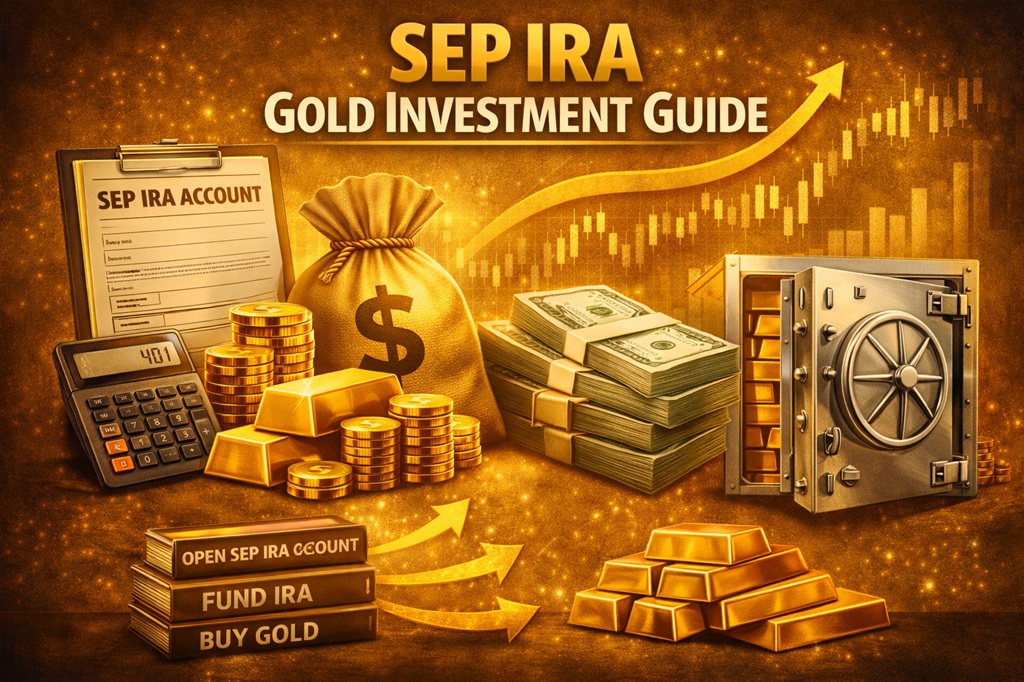
What Is a SEP IRA and How It Works for Self-Employed Investors
A SEP IRA, Simplified Employee Pension Individual Retirement Account, is a retirement plan designed specifically for self-employed individuals and small business owners. It’s governed by IRS Publication 560 and offers some of the highest contribution limits available in any retirement plan.
Unlike a 401(k), a SEP IRA doesn’t require complex plan documents or annual filings. You open an account, make contributions, and deduct them from your business income. That simplicity is a big part of why roughly 9.7 million self-employed Americans use one.
SEP IRA Basics Explained
A SEP IRA is funded entirely by the employer, meaning you, if you’re self-employed. Employees don’t contribute to their own SEP accounts. If you have employees, you must contribute the same percentage of compensation to their accounts as you do to your own.
Contributions are tax deductible, which reduces your taxable business income for the year. The funds grow tax-deferred until you take distributions in retirement.
This structure makes the SEP IRA one of the most powerful retirement savings tools available to self-employed professionals. The problem is that most people only ever use it to hold stocks and mutual funds. That leaves a significant diversification opportunity on the table.
SEP IRA Contribution Limits for 2026
For 2026, you can contribute up to 25% of your net self-employment compensation, with a maximum contribution of $72,000. The compensation used in that calculation is capped at $360,000.
To put that in perspective: a Traditional IRA caps contributions at $7,000 per year (or $8,000 if you’re 50 or older). A SEP IRA gives you more than ten times that ceiling.
For a self-employed investor earning $200,000 in net compensation, the maximum SEP contribution would be around $40,000 for the year. That’s a significant amount of capital that can be directed into gold and other IRS-approved precious metals, tax-deferred.
How Self-Employed Deduction Calculations Work
Here’s where it gets slightly technical. Because you’re both the employer and the employee, the IRS uses a reduced rate worksheet to calculate your actual contribution percentage. The effective rate works out to approximately 20% of net self-employment earnings after deducting half of your self-employment tax.
IRS Publication 560 includes a worksheet that walks you through the exact calculation. I always recommend running the numbers with a tax advisor before finalizing your contribution, especially if it’s your first year contributing.
The math isn’t difficult, but getting it wrong, even by a small amount, can mean excess contributions that trigger penalty taxes.
Can You Invest in Gold with a SEP IRA?
Yes. But not through a standard brokerage SEP IRA. To hold physical gold in a SEP IRA, you need to convert it, or open it, as a self-directed SEP IRA.
Self-Directed SEP IRAs and Alternative Investments
A self-directed IRA is simply a retirement account where the account holder directs the investments, rather than choosing from a brokerage’s preset menu of stocks, bonds, and funds.
With a self-directed SEP IRA, you can invest in alternative assets including physical precious metals, real estate, private equity, and more. The key difference is the custodian. Standard brokerages like Fidelity or Vanguard don’t allow physical metal holdings. You need a custodian that specializes in self-directed IRAs.
These custodians are IRS-approved, they handle the compliance paperwork, and they coordinate directly with approved depositories to store your metals. They don’t give investment advice, that’s your call. Their job is custody and compliance.
IRS Rules for Precious Metals in SEP IRAs
The IRS sets specific purity and eligibility standards for metals held in any IRA, including a SEP IRA. This falls under IRC Section 408(m).
Here’s what’s allowed:
- Gold: .995 purity minimum
- Silver: .999 purity minimum
- Platinum: .9995 purity minimum
- Palladium: .9995 purity minimum
Common examples of eligible coins include the American Gold Eagle, American Gold Buffalo, and the Canadian Maple Leaf. Not every gold coin qualifies, collectible or numismatic coins are generally excluded.
Metals must come from a refiner, assayer, or manufacturer accredited by NYMEX, COMEX, LBMA, or a national government mint. The mint mark and fineness must be clearly visible, and proof coins require original mint packaging with a certificate of authenticity.
If you purchase metals that don’t meet these standards inside your IRA, the IRS treats that as a distribution. That means taxes and potentially a 10% early withdrawal penalty if you’re under 59½.
Storage Requirements and Approved Depositories
This is one of the most important rules, and one of the most commonly misunderstood.
You cannot store IRA gold at home. You cannot store it in a personal safe. You cannot keep it in a safe deposit box that you control.
The IRS requires that all precious metals held in an IRA be stored in an IRS-approved third-party depository. Facilities commonly used include:
- Delaware Depository (Wilmington, DE)
- Brink’s Global Services
- IDS of Texas (Dallas, TX)
These vaults offer full insurance, 24/7 monitoring, and segregated or commingled storage options. Your custodian arranges the relationship with the depository on your behalf.
Taking personal possession of IRA metals, for any reason, is treated as a taxable distribution by the IRS. I’ve seen investors make this mistake and face both income tax and penalty bills they weren’t expecting.
SEP IRA Gold Investing Benefits for Business Owners
There are a few reasons self-employed investors find gold especially appealing inside a SEP IRA. Here’s an honest breakdown.
Tax Deduction Advantages for Self-Employed Investors
Every dollar you contribute to a SEP IRA reduces your taxable business income for that year. At the 2026 limit of $72,000, that’s a substantial deduction, one that could meaningfully lower your federal tax bill.
Inside the account, those contributions grow tax-deferred. You don’t pay taxes on gains, dividends, or appreciation until you take distributions. That deferred compounding can make a real difference over a 10–20 year horizon.
Portfolio Diversification with Precious Metals
Most retirement portfolios are heavily concentrated in equities and bonds. Precious metals have historically shown low correlation with stock market performance, meaning gold often moves independently of what the S&P 500 is doing.
Despite gold’s long track record, precious metals still represent less than 1% of total IRA allocations in the U.S. For self-employed investors who don’t have the cushion of a company pension or employer match, that kind of diversification can be especially meaningful.
Protection Against Market Volatility
Business income can be unpredictable. A bad quarter, a lost client, or a broader economic slowdown can all affect your cash flow. Holding a portion of your retirement savings in physical gold gives your portfolio an asset that doesn’t depend on corporate earnings reports or interest rate decisions.
Gold has served as an inflation hedge across multiple economic cycles. It’s not a guarantee against loss, but it does behave differently than paper assets, and that difference matters when markets get turbulent.
Costs and Fees of a Self-Directed SEP Gold IRA
I’ll be direct here: a gold SEP IRA costs more to maintain than a standard brokerage IRA. Knowing the numbers upfront prevents surprises later.
Setup and Custodian Fees
Opening a self-directed SEP IRA typically involves a one-time setup fee. Most custodians charge between $50 and $150 to process the account application and establish the account structure.
Annual administration fees, covering account maintenance, IRS reporting, and compliance oversight, generally run $75 to $300 per year, depending on the custodian and account value. Some custodians use flat fees; others scale with account size.
Storage and Insurance Costs
Because your metals must be held at an approved depository, you’ll pay annual storage fees. These typically range from $100 to $300 per year for standard accounts, or approximately 0.5% to 1% of asset value for larger holdings.
Segregated storage, where your specific metals are kept separate from other investors’ holdings, costs more than commingled storage but provides clearer documentation of exactly what’s yours. Your custodian can walk you through the options.
Dealer Premiums and Metal Pricing
When you buy physical gold for your IRA, you pay a dealer premium above the spot price. That spread typically runs 2% to 10%, depending on the metal, the coin or bar type, and market conditions.
This is one of the hidden cost areas I see investors overlook. Two dealers can quote very different prices for the same American Gold Eagle. Comparing providers before purchasing can save you real money, especially on larger purchases.
SEP IRA vs Solo 401(k) for Precious Metals Investors
If you’re self-employed and weighing your options, the SEP IRA and Solo 401(k) are the two main plans worth comparing.

Contribution Limits Comparison
Both plans share the same $72,000 employer contribution ceiling for 2026. The difference is that the Solo 401(k) also allows employee contributions, up to $23,500 in 2026, plus a $7,500 catch-up contribution if you’re 50 or older.
For high-income self-employed investors who want to sock away as much as possible, the Solo 401(k) can push total contributions higher than a SEP IRA alone.
Roth Options and Flexibility
The Solo 401(k) offers a Roth contribution option. That means you can make after-tax contributions that grow tax-free and come out tax-free in retirement.
SEP IRAs are traditional pre-tax only. There’s no Roth version of a SEP IRA. If tax-free retirement income is a priority for you, the Solo 401(k) gives you a path that the SEP doesn’t.
Simplicity vs Flexibility for Business Owners
The SEP IRA wins on simplicity. There’s no plan document requirement, no annual IRS filing (like a Form 5500), and the account is easy to set up and maintain.
The Solo 401(k) requires more administrative work. For investors who want higher contribution potential and Roth flexibility, that trade-off makes sense. For those who prefer low maintenance and still want solid contribution room, the SEP IRA is the easier path.
Common SEP IRA Gold Investing Myths
I hear these regularly. Let me clear them up.
Myth: SEP IRA Contributions Are Limited Like Regular IRAs
Not even close. A Traditional IRA caps at $7,000 per year. A SEP IRA caps at $72,000. They’re completely different structures with different rules. Don’t let anyone tell you a SEP IRA “isn’t worth the effort” based on contribution limits.
Myth: Physical Gold Is Not Allowed in an IRA
Physical gold is explicitly permitted under IRC Section 408(m), provided it meets the purity and custody requirements. This has been the case since the Taxpayer Relief Act of 1997. The rules are specific, but the allowance is real.
Myth: Precious Metals IRAs Have the Same Fees as Stock IRAs
They don’t. Storage fees, custodian fees, and dealer premiums add up to a higher annual cost than a standard brokerage IRA. That doesn’t make gold IRAs a bad choice, it just means you need to factor those costs into your decision and compare providers carefully.
Step-by-Step: How Self-Employed Investors Start a SEP Gold IRA
The process is more straightforward than most people expect.
Step 1: Open a SEP IRA with a Qualified Custodian
You need a custodian that specializes in self-directed IRAs, not a standard brokerage. They’ll provide the account application, identity verification paperwork, and the IRS Form 5305-SEP if needed. The setup process typically takes a few business days.
Step 2: Fund the Account
You have two main options. You can make a direct contribution from your business earnings, up to the 2026 limit of $72,000. Or, if you have funds in an existing Traditional IRA, Roth IRA, or 401(k), you can roll those assets over into the self-directed SEP IRA.
A direct rollover, where funds move directly from your old custodian to your new one, is the safest approach. It avoids the 60-day clock and the 20% tax withholding that can complicate an indirect rollover.
Step 3: Choose IRS-Approved Metals
Work with your custodian or a reputable dealer to select eligible metals. Gold bullion at .995 purity or better, eligible coins like the American Gold Eagle or Canadian Maple Leaf, and IRS-compliant silver, platinum, and palladium products are all options.
Your custodian will confirm eligibility before the purchase clears. Don’t buy metals independently and then try to transfer them in, that doesn’t work. For further information, look at the below lists:
Step 4: Arrange Secure Storage at an Approved Depository
Once the purchase is complete, your custodian coordinates delivery directly to the approved depository. You’ll receive documentation showing the metal type, weight, serial numbers, and storage location.
That chain of custody matters. It’s what distinguishes a compliant IRA holding from a taxable distribution.
Is a SEP IRA Gold Strategy Right for Your Business?
This strategy works well for a specific type of investor. If you’re self-employed, a freelancer, consultant, independent contractor, or small business owner, and you’re already contributing to a SEP IRA, adding a precious metals allocation is worth exploring.
It’s especially relevant if you’re within 10–20 years of retirement, concerned about inflation, or holding a portfolio that’s heavily weighted toward equities. Gold doesn’t replace stocks. It plays a different role, lower correlation, different risk profile, tangible store of value.
That said, gold does carry its own volatility. The fees are real. And this isn’t a passive set-it-and-forget-it investment in the same way a broad index fund is. You’ll want to review your allocation periodically and understand what you’re holding.
I’d also strongly recommend consulting a tax advisor before making significant contributions or rollovers. The SEP deduction calculation has nuances that matter, and the right professional can help you avoid overage mistakes.
Final Thoughts on SEP IRA Gold Investments for Self-Employed
A SEP IRA is one of the most powerful retirement tools available to self-employed Americans, and most people are only using a fraction of what it can do.
Adding physical gold through a self-directed SEP IRA gives you the tax advantages of a qualified retirement account combined with an asset that has historically served as a store of value through economic uncertainty.
The rules are specific. The fees are higher than a standard brokerage account. But for the right investor, it’s a legitimate, IRS-compliant way to diversify your retirement savings with something tangible.
If you’re just starting to research this, the best first step is getting familiar with how gold IRAs actually work before making any decisions.
Frequently Asked Questions About SEP IRA Gold Investments
Can I roll over an existing 401(k) into a self-directed SEP IRA to buy gold?
Yes. You can roll over funds from a 401(k), Traditional IRA, 403(b), or 457(b) into a self-directed SEP IRA. A direct rollover, where the funds transfer directly between custodians, is the cleanest approach. It avoids the 60-day rule and the mandatory 20% federal tax withholding that applies to indirect rollovers from employer-sponsored plans.
Do I have to invest my entire SEP IRA in gold?
No. Most investors allocate a portion of their SEP IRA to precious metals, often 5% to 20%, while keeping the rest in more traditional assets. There’s no IRS rule requiring you to go all-in on gold. Diversification is the point.
What happens if I take physical possession of the gold in my SEP IRA?
The IRS treats it as a taxable distribution. You’d owe ordinary income tax on the value of the metals, plus a 10% early withdrawal penalty if you’re under 59½. This is one of the most costly mistakes I see, and it’s entirely avoidable by working with a custodian who stores the metals on your behalf.
Can I contribute to both a SEP IRA and a Traditional IRA in the same year?
Yes. You can contribute to both in the same tax year. However, your ability to deduct the Traditional IRA contribution may be limited depending on your income and whether you or your spouse is covered by any workplace retirement plan. A tax advisor can help you figure out what’s deductible in your specific situation.
Are there income limits for contributing to a SEP IRA?
No income limits apply to SEP IRA contributions, unlike Traditional or Roth IRAs. As long as you have self-employment income, you can contribute, up to the 25% of compensation ceiling or $72,000, whichever is lower. That’s one of the SEP IRA’s real strengths.
What’s the deadline for making a SEP IRA contribution for 2026?
You have until your tax filing deadline, including extensions. For most self-employed individuals, that’s April 15, 2027, or October 15, 2027 if you file an extension. This gives you flexibility to calculate your final net earnings and contribution amount before committing.
Is gold actually a good investment for retirement?
That depends on your goals and timeline. Gold isn’t a growth asset in the way stocks are. Historically, it’s held its value over long periods and tended to perform differently than equity markets during downturns. Most financial professionals view it as a diversifier rather than a primary growth driver. Whether it belongs in your retirement account is a decision that should factor in your age, risk tolerance, and overall portfolio.
What’s the difference between a gold IRA and a regular gold investment?
A gold IRA holds physical metals inside a tax-advantaged retirement account. Your contributions (for a SEP IRA) are tax-deductible, and gains grow tax-deferred until withdrawal. A regular gold investment, buying coins or bars outside an IRA, doesn’t carry those tax advantages. Any gains are subject to capital gains tax when you sell, and physical gold held at home doesn’t benefit from the IRS-approved custody structure.
How long does it take to set up a self-directed SEP IRA for gold?
Most accounts can be opened within a few business days once your application and identity verification are complete. Funding via rollover can take anywhere from 5 to 14 business days, depending on the sending custodian. Purchasing metals and arranging depository storage typically adds another few days after funds are confirmed.
What should I look for when choosing a gold IRA custodian?
Look for a custodian with clear fee structures, experience handling self-directed IRAs specifically, and established relationships with IRS-approved depositories. Watch for custodians that are vague about storage arrangements or push you toward specific dealers without full transparency on pricing. Compare at least two or three options before opening an account.