
Consolidating Multiple 401(k) Accounts Into One Gold IRA
If you’ve changed jobs a few times over your career, there’s a good chance you have retirement accounts scattered across multiple former employers. Two old 401(k)s. Maybe three. Each one sitting with a different plan administrator, each charging its own fees, each requiring its own login and annual statement.
It’s more common than most people realize. With over $49.1 trillion in U.S. retirement assets spread across the country, a significant portion of that is sitting in forgotten or neglected old employer plans, quietly accumulating fees while the account holder has moved on.
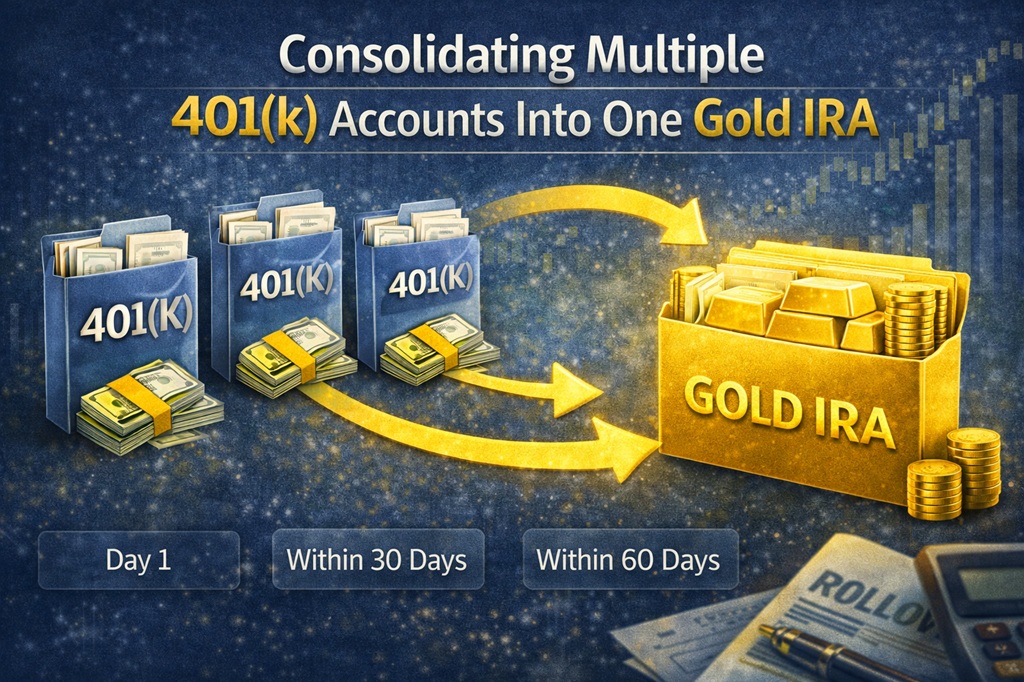
Consolidating those accounts into a single self-directed Gold IRA is a strategy more investors are using to simplify their retirement picture and add precious metals exposure at the same time. Done correctly through direct trustee-to-trustee rollovers, it’s a tax-free process with no IRS penalties.
In this guide, I’ll walk through exactly how it works, what to watch out for, and what to expect from the timeline.
Why Investors Consolidate Multiple 401(k) Accounts
The case for consolidation isn’t just about gold. It starts with a basic organizational problem that compounds over time.
The Problem With Multiple Old 401(k) Plans
Every time you change employers, you leave behind a 401(k). Your new job has its own plan, so the old one just sits there. Then you change jobs again. Now there are two old accounts.
Each of those accounts has its own annual administrative fee. Each has its own investment menu you’re no longer paying attention to. Each requires a separate login, separate beneficiary designations, and separate RMD calculations once you reach age 73.
The Investment Company Institute has documented this pattern extensively, job-changers routinely accumulate multiple retirement accounts over their careers, and many never consolidate them. The result is a fragmented retirement picture that’s harder to manage, harder to optimize, and often more expensive than it needs to be.
Consolidating multiple 401(k)s into a single self-directed Gold IRA solves the organizational problem while adding an asset class, physical precious metals, that a standard 401(k) menu almost never offers.
Portfolio Streamlining and Simplified Retirement Management
One account. One custodian. One annual statement. One set of beneficiary designations to keep current.
That’s what consolidation delivers on the management side. Instead of logging into three separate platforms to check your retirement balances, you have a single dashboard showing your complete precious metals holdings, their current value, and your depository storage details.
For RMD purposes, Required Minimum Distributions starting at age 73, having a single account simplifies the annual calculation considerably. Managing distributions from multiple accounts at different institutions is an administrative burden that consolidation eliminates.
Fee Reduction Through Account Consolidation
Old 401(k) plans charge fees. Sometimes those fees are low, large employer plans often have institutional pricing. But smaller employer plans can carry annual administrative fees, investment expense ratios, and record-keeping charges that add up.
When you exit a 401(k) through a rollover, there may be a one-time distribution processing fee, typically $50 to $150 per account. That’s a one-time cost to exit.
On the receiving end, a self-directed Gold IRA carries its own ongoing fees, custodian administration typically runs $175 to $300 annually, plus storage fees for the physical metals. But instead of paying those fees separately across three old accounts, you’re paying them once on a consolidated balance. Over a 10 to 15 year horizon, that difference is real money.
IRS Rules for Rolling Multiple 401(k)s Into a Gold IRA
Before moving any funds, it’s worth understanding the IRS framework governing these rollovers. The rules are clear, and following them precisely is what keeps the process tax-free.
Direct Trustee-to-Trustee Transfers (Recommended Method)
A direct rollover means your 401(k) plan administrator sends the funds directly to your new Gold IRA custodian. You never receive the money personally. It moves institution-to-institution, and the IRS treats it as a non-taxable transfer.
Under IRS Publication 590-A, there is no limit on the number of direct trustee-to-trustee transfers you can do in a 12-month period. That means you can roll over all three of your old 401(k)s in the same year without any restriction, as long as each one is a direct transfer.
No taxes are triggered. No penalties apply. The funds maintain their tax-deferred status inside the new self-directed IRA from the moment they arrive.
This is the method I always recommend, and it’s the method the vast majority of rollovers use.
Indirect Rollovers and Why They’re Rare
An indirect rollover means the 401(k) plan distributes the funds to you directly, usually as a check, and you then have 60 days to deposit the full amount into a qualifying IRA.
The problem is that employer-sponsored plans are required by the IRS to withhold 20% for federal taxes on indirect distributions. If you’re rolling over $80,000 from an old 401(k) and you receive an indirect distribution, the plan sends you $64,000 and keeps $16,000 for federal tax withholding.
To complete a full rollover and avoid taxation on that withheld amount, you’d need to deposit $80,000 into the new IRA within 60 days, meaning you’d have to cover the $16,000 shortfall from your own pocket. You’d eventually recover the withheld amount when you file your taxes, but that’s a cash flow burden most investors would rather avoid.
There’s also the once-per-12-month limitation on indirect IRA-to-IRA rollovers. Direct transfers don’t carry this restriction. Industry data consistently shows that well over 95% of rollovers use the direct method, and for good reason.
Precious Metals Compliance Requirements
Once the funds arrive in your self-directed Gold IRA, the metals you purchase must meet IRS purity standards under IRC Section 408(m):
- Gold: .995 purity minimum
- Silver: .999 purity minimum
- Platinum: .9995 purity minimum
- Palladium: .9995 purity minimum
Common eligible products include American Gold Eagles, American Gold Buffalos, Canadian Maple Leafs, and IRS-compliant gold bullion bars from accredited refiners.
All metals must be held in an IRS-approved depository, facilities like Delaware Depository, Brink’s Global Services, or IDS of Texas. Personal possession of IRA metals is prohibited. Your custodian manages the entire storage relationship on your behalf.
Step-by-Step Guide to Consolidating Multiple 401(k)s Into a Gold IRA
The process is straightforward once you know the sequence. Here’s exactly how I’d walk through it.
Step 1 – Open a Self-Directed Gold IRA
Before any rollover can happen, you need a receiving account. Choose a custodian that specializes in self-directed IRAs with precious metals experience, not a generalist brokerage that treats gold as a side offering.
Complete the account application, provide identity verification documentation, and name your beneficiaries. Most specialized custodians can have your account open within one to three business days once they receive a complete application.
This is the foundation everything else builds on. Take your time choosing the right custodian. Look for transparent fee structures, established relationships with IRS-approved depositories, and a clear process for handling multiple rollovers. Once the account is open, you’re ready to initiate transfers.
Step 2 – Identify All Old 401(k) Accounts
Before initiating any rollovers, take inventory of every retirement account you have. This sounds obvious, but I’ve worked with investors who discovered accounts they’d completely forgotten about when they started this process.
For each old 401(k), gather:
- The plan administrator’s name and contact information
- Your account number and current balance
- Whether the account has any outstanding loan balance
- Whether the plan has any restrictions on distributions or rollovers
Outstanding loan balances in a 401(k) are a critical issue. If you have an unpaid loan against a 401(k) and you roll that account out without resolving the loan, the IRS typically treats the outstanding balance as a taxable distribution, subject to ordinary income tax and potentially the 10% early withdrawal penalty if you’re under 59½.
Resolve any loans before initiating the rollover, or confirm with the plan administrator exactly how loan balances are handled on distribution.
Step 3 – Initiate Sequential Rollovers
Here’s something I see investors get wrong: trying to move all their accounts simultaneously.
The instinct makes sense; you want it done as fast as possible. But initiating three rollovers at the same time creates overlapping administrative processes that can slow each individual transfer down. Your new custodian is coordinating with three different plan administrators simultaneously. Paperwork for all three is in flight at once. If one account has an issue, it can create confusion with the others.
The cleaner approach is sequential rollovers, completing one transfer before initiating the next. Your custodian processes the first rollover from start to finish, the funds land, and then you initiate the second. This keeps each transfer clean and fully documented before the next one begins.
For each rollover, contact the old plan administrator directly and request a direct rollover to your new Gold IRA custodian. Your new custodian will provide the account name, account number, and mailing or wire information that the sending plan needs. Fill out the plan’s distribution form completely and accurately; the same small errors that delay single rollovers delay multiple ones.
Step 4 – Fund the Gold IRA and Purchase Metals
Once funds from each rollover arrive and are confirmed in your self-directed Gold IRA, you direct the custodian to purchase your chosen metals. This is done through an asset direction letter, a document specifying exactly which products you want, in what quantities.
Your custodian coordinates the purchase through an approved dealer. You don’t handle the purchase personally. The dealer ships the metals directly to your designated depository, where they’re received, verified, and added to your account inventory with full documentation.
You can purchase metals after each individual rollover arrives, or wait until all accounts have been consolidated and make a single coordinated purchase. The right approach depends on your preferences and any timing considerations around metal prices.
Timeline for Multiple 401(k) Rollovers
Each individual rollover follows the same 2-to-4-week process I outlined in my rollover timeline guide. With multiple accounts, you’re stacking those timelines sequentially:
| Number of 401(k)s | Estimated Total Time |
| 1 account | 2–4 weeks |
| 2 accounts | 4–6 weeks |
| 3 accounts | 6–8 weeks |
These are estimates based on typical processing speeds. If your old plan administrators process transfers quickly and your paperwork is complete, you may move faster. If any individual plan has a slow distribution process, that rollover will take longer than average.
The sequential approach means the full consolidation of three accounts might take six to eight weeks from start to finish. That’s a meaningful commitment of time and attention, but it’s a one-time process, and the simplified management on the other side lasts for the rest of your retirement.
Key Benefits of Consolidating Retirement Accounts Into a Gold IRA
Once the consolidation is complete, the practical advantages are real and ongoing.

Simplified Retirement Portfolio Management
Managing one account is categorically easier than managing three. One custodian relationship. One annual statement. One set of investment decisions. One beneficiary designation to keep current.
For investors approaching retirement, this simplicity matters more than it might seem. When RMDs begin at age 73, calculating the required distribution from a single Gold IRA is straightforward. Coordinating RMDs across multiple accounts at different institutions, some of which may have changed administrators, merged, or updated their systems, adds friction and risk of error.
The reporting is cleaner too. Your custodian handles annual IRS reporting, Forms 5498 and 1099-R, for the consolidated account. That’s one set of tax documents instead of three or four.
Potential Fee Savings Over Time
The fee calculation depends on what your old plans were charging. Large employer 401(k) plans often have very low expense ratios, they negotiate institutional pricing that individual investors can’t access.
But smaller plans, older plans, and plans from employers who’ve since changed administrators can carry fees that investors aren’t paying close attention to. Annual record-keeping fees, administrative charges, and investment expense ratios from actively managed funds inside old plans can collectively amount to more than the consolidated Gold IRA’s flat custodian and storage fees.
The only way to know if consolidation saves you money on fees is to add up exactly what each old account is costing you annually and compare that to the projected cost of the Gold IRA. Your new custodian should be able to give you that number clearly.
Stronger Precious Metals Allocation Strategy
With all your retirement capital in one account, you can think about your precious metals allocation as a single coordinated strategy rather than a piecemeal one.
Instead of having a small gold allocation in one account and uncoordinated equity positions in two others, consolidation lets you make a deliberate decision about what percentage of your total retirement savings you want in precious metals, and execute that decision consistently.
For investors using gold as an inflation hedge or as a low-correlation diversifier against equity market risk, that coordinated view of total portfolio allocation is more effective than managing it in fragments.
Common Mistakes When Consolidating Multiple 401(k)s
I’ve seen these errors come up enough times that they’re worth covering directly.
Attempting an Indirect Rollover
With multiple accounts, the temptation to take an indirect rollover, receiving the funds personally and then depositing them, is even more problematic than with a single account.
Remember: employer-sponsored plans withhold 20% for federal taxes on indirect distributions. If you’re trying to roll over three accounts totaling $300,000, you’d receive $240,000 in checks, need to deposit $300,000 within 60 days to avoid taxation on the withheld $60,000, and scramble to cover that gap from other funds.
That’s a stressful and entirely avoidable situation. Use direct transfers. Every time.
Ignoring Old Plan Restrictions
Not every 401(k) allows immediate rollovers under all circumstances. Some plans have waiting periods after separation from service. Some require a minimum age before distribution. A few have restrictions on partial rollovers, they may only allow a full account distribution rather than a partial one.
And as I mentioned earlier, outstanding loan balances are a real problem. An unpaid loan in a 401(k) that you roll out can trigger a taxable distribution on the loan amount. Confirm the loan status and plan-specific rules with each administrator before initiating any transfer.
Mishandling Precious Metals Storage
Once metals are inside your consolidated Gold IRA, the IRS storage rules are non-negotiable. The metals must stay in an IRS-approved depository. You cannot take personal possession, not temporarily, not for “safekeeping,” not for any reason.
If you take physical possession of IRA metals, the IRS deems it a distribution. The full fair market value of those metals becomes taxable income in that year. If you’re under 59½, the 10% early withdrawal penalty applies on top of that.
I’ve seen investors make this mistake, usually because they misunderstood what “self-directed” means. Self-directed refers to your ability to choose alternative assets. It doesn’t mean you personally hold those assets. The custodian and depository handle all physical custody.
Choosing a Custodian for Multi-Account Consolidation
For a single rollover, custodian selection matters. For consolidating multiple accounts, it matters even more. You’re trusting this institution to coordinate several sequential transfers cleanly and efficiently.
Features to Look for in a Gold IRA Custodian
Not all self-directed IRA custodians handle multi-account consolidations with equal competence. Here’s what to look for specifically when you’re bringing in more than one old plan.
Rollover experience: The custodian should have documented experience handling multiple simultaneous or sequential 401(k) rollovers. Ask directly how many multi-account consolidations they process and what their typical timeline looks like.
Dedicated specialist: A custodian that assigns a dedicated rollover specialist, a single point of contact who manages your case throughout the process, is significantly more effective than one with a general customer service queue. When you have three rollovers in various stages, you want one person who knows your full situation.
Depository relationships: Confirm which IRS-approved depositories the custodian works with and what the storage options look like, segregated vs commingled, fee structure, reporting frequency. For a consolidated account with meaningful metal holdings, knowing exactly where your metals are and how they’re documented matters.
Transparent fee structure: Get the complete fee schedule in writing before opening the account. Setup fees, annual administration fees, storage fees, and any transaction fees for buying or selling metals should all be clearly stated.
Questions Investors Should Ask Before Consolidating
Before committing to any custodian for a multi-account consolidation, I’d ask these questions directly:
- What is your typical timeline for a direct rollover from an employer 401(k)?
- Can you handle multiple rollovers from different administrators simultaneously, or do you recommend sequential processing?
- What are your complete annual fees, custodian administration, storage, and any transaction fees?
- Which IRS-approved depositories do you use, and do you offer segregated storage?
- Do you have a dedicated rollover specialist who will manage my account throughout the process?
- Are there exit fees or transfer fees if I need to move the account later?
A custodian who gives you clear, specific answers to all of these, without vague assurances, is demonstrating the operational competence that makes a multi-account consolidation go smoothly.
Request a Gold IRA Information Kit
If you’re still evaluating your options, the right starting point is a Gold IRA information kit from providers you’re considering. These kits break down the process, explain the fee structure, and give you a clearer sense of how each company approaches the rollover experience.
Most reputable providers offer them at no cost and with no obligation to proceed.
[Get Your Free Gold IRA Kit]
Final Takeaway: Streamlining Retirement Accounts With a Gold IRA
Consolidating multiple old 401(k)s into a single self-directed Gold IRA solves two problems at once: the administrative fragmentation of managing accounts at multiple institutions, and the limited investment menu that keeps most employer plans locked out of physical precious metals.
The process works. The IRS permits it. Direct trustee-to-trustee rollovers from multiple 401(k) accounts into a single self-directed Gold IRA are tax-free and penalty-free when executed correctly.
Plan for a total timeline of six to eight weeks if you’re consolidating three accounts sequentially. Verify loan balances and plan-specific restrictions before initiating any transfers. Use direct rollovers exclusively. And choose a custodian with demonstrated experience managing this kind of multi-account consolidation, not one that’s learning on your account.
The result on the other side is one account, one custodian, and a coherent precious metals allocation strategy you can actually manage clearly.
Frequently Asked Questions: Consolidating Multiple 401(k)s Into a Gold IRA
Can I roll over multiple 401(k)s into a single Gold IRA in the same year?
Yes. There is no IRS limit on the number of direct trustee-to-trustee transfers you can complete in 12 months. You can roll over two, three, or more old 401(k) accounts into a single self-directed Gold IRA in the same tax year, provided each one uses the direct transfer method. The annual IRA contribution limit does not apply to rollover amounts.
Do I have to consolidate all my old 401(k)s, or can I roll over just one?
You can roll over as many or as few accounts as you choose. There’s no requirement to consolidate everything at once, or at all. Some investors roll over one old account to start, evaluate the experience, and then decide whether to bring in additional accounts. Others consolidate everything in a single coordinated process. The decision is entirely yours.
What if one of my old 401(k)s has an outstanding loan balance?
This is a critical issue to resolve before initiating any rollover. If you roll out of a 401(k) with an outstanding loan, the IRS typically treats the unpaid loan balance as a taxable distribution, subject to ordinary income tax and potentially the 10% early withdrawal penalty if you’re under 59½. Contact the plan administrator before initiating the transfer to understand exactly how the loan will be handled and what your options are.
Will I owe taxes when I consolidate multiple 401(k)s into a Gold IRA?
Not with direct rollovers. When funds move directly from your 401(k) plan administrator to your new Gold IRA custodian, the transfer maintains tax-deferred status throughout. No taxes are triggered at the time of transfer. You pay ordinary income tax on distributions when you eventually withdraw in retirement, same as any Traditional IRA.
Can I still contribute to the Gold IRA after completing the rollovers?
Yes. After your rollovers are complete, you can continue making annual IRA contributions up to the 2026 limit, $7,000, or $8,000 if you’re 50 or older, subject to income and eligibility rules. Your rollover funds and new contributions simply sit in the same self-directed account. The rollover amounts do not count against your annual contribution limit.
How do I find old 401(k) accounts I may have forgotten about?
Start with your old pay stubs or W-2s, they often list the plan administrator. You can also contact former employers directly and ask for their HR or benefits department. The National Registry of Unclaimed Retirement Benefits is another resource worth checking. If an employer has gone out of business, the Department of Labor’s abandoned plan database can help locate where the account was transferred.
Is a Gold IRA the right destination for all my old 401(k) funds?
Not necessarily for everyone. A Gold IRA is a strong choice for investors who want precious metals exposure in a tax-advantaged account, value portfolio diversification, and are comfortable with the higher fee structure that physical metals storage requires. But if you have a very large balance and low-cost index fund options inside your current plan, it’s worth comparing the full cost picture before consolidating. The decision should be based on your specific situation, not a blanket assumption that consolidation is always the right move.
What happens to my metals in the Gold IRA if my custodian goes out of business?
Your metals are not held by the custodian, they’re held in a separate, IRS-approved depository in your account’s name. If your custodian ceases operations, your metals remain at the depository and are protected. You would simply transfer the account to a new custodian. This is one of the reasons the physical separation between custodian and depository exists, it protects account holders from custodian-level business risk.
Disclosure: IRA Gold Kits is an educational resource and referral platform. We are not licensed financial advisors. Some companies featured on this site may compensate us for referrals. Content is for informational purposes only and does not constitute investment or tax advice. Always consult a qualified tax or financial professional before making retirement planning decisions.