
Gold vs Silver for IRA Investment
I’ve spent 25 years helping investors decide between gold and silver for their retirement accounts, and the question never gets old: which metal belongs in your IRA? The answer depends on your risk tolerance, retirement timeline, and what you’re trying to accomplish with precious metals.
Gold sits at $5,052 per ounce in February 2026. Silver trades around $111 per ounce as of January 2026. The U.S. IRA market holds $18.9 trillion in total assets, yet only 0.5-1% of that sits in precious metals IRAs. Most investors still don’t understand how these metals work differently or which fits their retirement goals.
Gold is the stable, defensive play. Central banks buy it, investors flock to it during uncertainty, and it moves less dramatically than silver. Silver is the growth-oriented option with higher volatility, stronger industrial demand, and potential for bigger gains during bull markets.
The gold-to-silver ratio compressed from 99:1 in early 2020 to roughly 50:1 in 2026. This tells me market dynamics have shifted, with silver gaining ground relative to gold. Understanding this relationship helps you make smarter allocation decisions.
I’ll break down how each metal performs, their different risk profiles, and how to structure allocations based on your specific retirement situation. By the end, you’ll know whether your IRA needs more gold stability, silver growth potential, or a balanced mix of both.
Learn how to diversify your IRA with precious metals that match your retirement goals.
Market Overview: Gold and Silver in 2026
The precious metals market represents roughly $565 billion globally. Both gold and silver posted strong gains in 2025, but they moved very differently. Gold climbed 74% year-over-year, while silver surged 145%. That performance gap reflects silver’s higher volatility and leverage to precious metals sentiment.
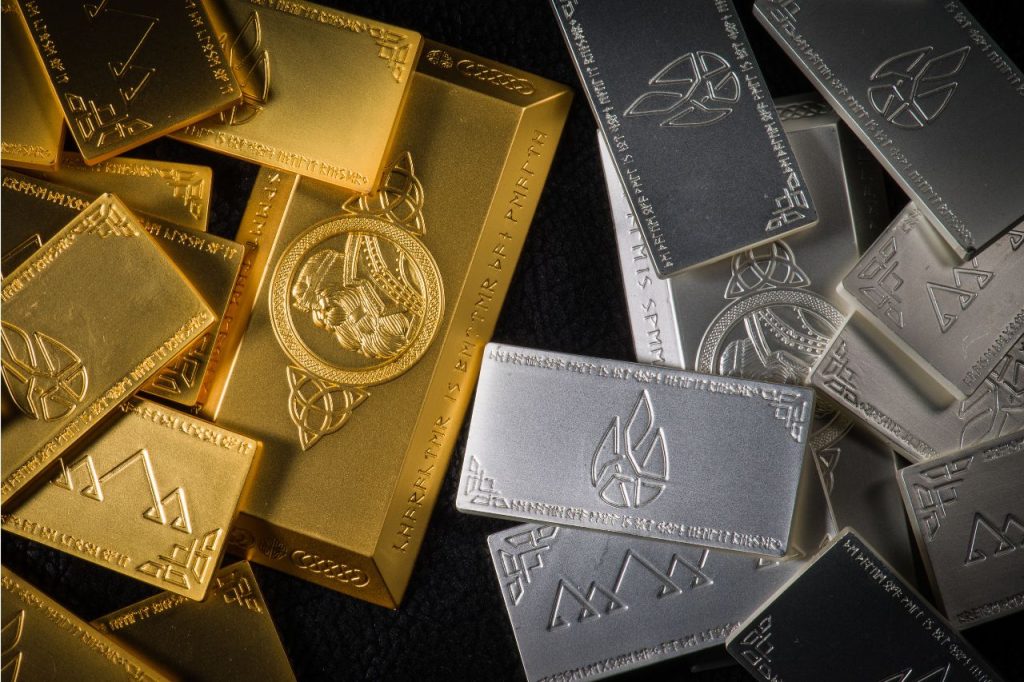
Gold as a Monetary Safe-Haven Asset
Gold demand exceeded 5,000 tons in 2025, driven by central bank purchases and investor safe-haven buying. Central banks alone added 297 tons during the year, continuing a multi-year accumulation trend.
I’ve watched gold serve as portfolio insurance through multiple crises. During the 2008 financial crisis, gold held steady while stocks crashed. During the 2020 pandemic, gold climbed while markets tanked. This consistent behavior during uncertainty makes it the cornerstone of defensive precious metals allocations.
Gold doesn’t depend on industrial demand. Its value comes from being money, a store of wealth that’s recognized globally. When currencies lose purchasing power through inflation, gold typically maintains or increases its value. This inflation hedge characteristic matters for retirees on fixed incomes.
Central bank buying at 297 tons annually signals institutional confidence. These aren’t retail investors chasing trends. These are sovereign nations diversifying reserves away from fiat currencies. When the world’s financial institutions add gold, individual investors should pay attention.
Silver’s Dual Role: Precious + Industrial
Silver industrial demand is projected around 700 million ounces for 2026. Solar panel manufacturing alone accounts for roughly 143 million ounces. Electric vehicles, electronics, and medical applications drive additional demand.
This industrial component makes silver behave differently than gold. During economic growth periods when industrial production increases, silver demand rises. During recessions when factories slow, silver demand falls. This creates volatility that gold doesn’t experience.
Silver volatility runs 2-3 times higher than gold in my experience. A 5% move in gold might correspond to a 10-15% move in silver. This amplification works both ways. Bull markets deliver bigger gains in silver. Bear markets create steeper losses.
The supply deficit matters for long-term investors. Silver has now posted five consecutive years of supply deficits, meaning demand exceeds new production. This structural imbalance supports higher prices over time, though short-term volatility remains significant.
Understanding the Gold/Silver Ratio
The gold-to-silver ratio tells you how many ounces of silver equal one ounce of gold. In February 2026, the ratio sits around 50:1. Historically, it averages closer to 60:1 over long periods.
A compressed ratio (lower numbers) means silver has gained relative to gold. The ratio hit 99:1 in early 2020 when fear peaked and investors fled to gold. As markets stabilized, silver rallied harder than gold, compressing the ratio to current levels.
I use this ratio for allocation signals. When it’s extremely high (80:1 or above), silver looks cheap relative to gold. When it’s low (below 50:1), gold looks relatively cheaper. These aren’t trading signals for retirement accounts, but they inform long-term positioning.
The current 50:1 ratio suggests silver has already enjoyed significant gains relative to gold. New IRA investors might consider gold-heavy allocations, while existing holders might rebalance by adding more gold. But this is one factor among many in allocation decisions.
Volatility, Risk, and Return Profiles
Gold has delivered 11.8% compound annual growth rate since 2000. Silver managed 7.9% over the same period. Yet in 2025’s bull market, silver crushed gold with 145% gains versus gold’s 64%. This captures the essential trade-off: gold offers steadier long-term returns, silver provides explosive upside during rallies.
Price Volatility and Beta Explained
Silver’s beta to gold runs around 2-3, meaning it amplifies gold’s moves. When gold rises 10%, silver might gain 20-30%. When gold falls 10%, silver could drop 20-30%. This leverage creates opportunity and risk.
The fifth consecutive year of supply deficit supports silver’s structural case. When demand consistently exceeds supply, prices should rise over time. But this doesn’t eliminate short-term volatility driven by economic cycles and investor sentiment.
IRA value swings matter more as you approach retirement. If you’re 10 years from retirement with $100,000 in silver and it drops 30% during a correction, you’re down to $70,000 with limited recovery time. That same position in gold might only drop 15%, leaving you at $85,000.
I’ve seen investors get shaken out of silver positions during corrections because they couldn’t handle the volatility. If you’re going to hold silver in your IRA, you need stomach for significant short-term price swings.
Bull Markets vs Defensive Periods
Silver outperforms dramatically during precious metals bull markets. The 145% gain in 2025 demonstrates this. When investor sentiment turns positive on metals, silver’s industrial demand and smaller market size create explosive moves.
Gold performs better during macro uncertainty and defensive periods. When geopolitical tensions rise, currencies wobble, or financial systems face stress, investors buy gold. Silver might rise too, but gold leads during these periods.
Understanding which environment you’re in helps guide allocations. In early 2026, we’re arguably still in a bull market for precious metals driven by inflation concerns and central bank buying. This favors silver exposure. But if economic conditions deteriorate into recession, gold’s defensive characteristics become more valuable.
Which Metal Is Too Risky for Retirement?
The fear of volatility eroding retirement capital is legitimate. Overexposure to silver can create gut-wrenching account swings that tempt you to sell at the worst times. Under-diversification into only gold might mean missing growth opportunities.
The consequence of getting this wrong is either accepting excessive volatility you can’t stomach, or holding too much stable gold and underperforming during bull markets. Neither outcome serves retirement goals.
My solution is structured allocation within the 5-15% precious metals range. A conservative approach might be 8% gold, 2% silver (80/20 split). A growth-oriented approach might be 5% gold, 10% silver (33/67 split). This frames the decision within appropriate total exposure limits.
Historical CAGR and volatility comparisons prove the trade-off. Gold’s 11.8% return with lower volatility beats silver’s 7.9% return with higher volatility over long periods. But silver’s occasional explosive moves create catch-up opportunities for growth-focused allocations.
Portfolio Allocation Strategies for U.S. IRAs
I recommend 5-15% total precious metals exposure for most retirement portfolios. Where you land within that range and how you split between gold and silver depends on your specific situation.
The $18.9 trillion U.S. IRA market has only 0.5-1% penetration in precious metals. This suggests significant room for growth as more investors discover these options. Early adopters benefit from positioning before broader acceptance.
Compare trusted Gold IRA providers to find the right custodian for your allocation strategy.
Conservative Allocation (Gold-Weighted)
A conservative allocation prioritizes capital preservation and inflation protection. I typically suggest 70-80% gold, 20-30% silver for investors within 10 years of retirement or those with low risk tolerance.
Gold’s inflation hedge characteristics protect purchasing power. As the dollar loses value, gold historically maintains or increases its worth. Central bank demand at 297 tons annually provides price support independent of market sentiment.
This allocation accepts lower upside potential in exchange for reduced volatility. You won’t capture silver’s full explosive moves during bull markets, but you won’t suffer its steep drops during corrections either.
A practical example: $50,000 precious metals position might hold $40,000 in gold (80 ounces at current prices) and $10,000 in silver (90 ounces). This gives meaningful silver exposure for growth while maintaining gold’s stability as the foundation.
Growth-Oriented Allocation (Silver-Leaning)
Growth-oriented allocations flip the ratio, holding 60-70% silver and 30-40% gold. This makes sense for investors 15+ years from retirement who can weather volatility and want to maximize precious metals upside.
Silver’s leverage to industrial growth positions it for solar panel and electric vehicle demand expansion. The 143 million ounces used in solar applications alone could grow significantly as renewable energy adoption accelerates.
Tariff impacts on industrial metals create uncertainty but also opportunity. Supply chain disruptions or trade restrictions could tighten silver supply further, supporting prices. But these same factors could dampen industrial demand during economic slowdowns.
A practical example: $50,000 position might hold $35,000 in silver (315 ounces) and $15,000 in gold (3 ounces). This delivers maximum silver exposure while maintaining some gold as portfolio ballast.
The risk is obvious. If silver crashes 40% during a correction, your $35,000 position drops to $21,000. Can you handle that without panic selling? If not, dial back silver exposure to levels you can actually hold through volatility.
Ratio-Based Rebalancing Strategy
The gold-to-silver ratio provides rebalancing signals for active managers. When the ratio hits 60:1 (above the current 50:1), silver looks relatively cheap. Consider adding silver or rebalancing existing positions toward it. When the ratio drops to 40:1, gold looks relatively cheap.
This approach requires more hands-on management than static allocations. You’re not day trading, but you are adjusting positions based on relative value signals once or twice per year.
Historical benchmarks suggest 60:1 represents fair value based on long-term averages. The current 50:1 ratio means silver has outperformed recently and might be due for mean reversion. But ratios can stay compressed or extended for years.
Volatility-adjusted allocations account for silver’s higher price swings. If you’re targeting equal dollar exposure to gold and silver, silver will create 2-3 times more portfolio volatility than gold. Account for this by weighting gold more heavily if you want balanced risk contribution.
IRS Rules and Compliance for Gold and Silver IRAs
Both gold and silver IRAs follow the same self-directed IRA rules. You need an approved custodian, IRS-approved metals, and secure depository storage. The metals must meet purity standards and cannot be stored at home.
Approved Metals and Purity Standards
Gold must be 99.5% pure for IRA inclusion. Approved products include American Gold Eagles (specially exempted at 91.67% purity), Canadian Gold Maple Leafs (99.99%), Austrian Gold Philharmonics (99.99%), and bars from approved refiners.
Silver requires 99.9% purity. American Silver Eagles, Canadian Silver Maple Leafs, and approved refiner bars all qualify. These products trade close to spot price with modest premiums.
IRS Publication 590-A and 590-B provide federal compliance references for retirement account rules. These publications outline what you can hold, distribution requirements, and tax treatment. Following these guidelines keeps your IRA compliant. Here’s two guides on IRA approved coins and IRA approved bars.
State tax considerations vary but rarely affect federal IRA rules. Most states exempt investment-grade bullion from sales tax. The IRA structure defers all taxes until distribution regardless of state rules.
Storage and Custodian Requirements
IRS-approved depositories provide secure storage with insurance and 24/7 monitoring. Delaware Depository, Brink’s Global Services, and International Depository Services are major facilities handling precious metals IRAs.
U.S.-based custodians must be approved to hold retirement accounts. Banks, trust companies, and specialized IRA custodians qualify. Your custodian coordinates with the depository to ensure proper storage and documentation.
Prohibited transactions include taking personal possession of IRA metals before retirement age. This disqualifies the entire account, making the full balance immediately taxable plus penalties if you’re under 59½.
Tax consequences of violations are severe. A $100,000 Gold IRA taken into personal possession creates $100,000 in taxable income that year. If you’re under 59½, add a $10,000 penalty (10%). This can easily trigger 30-40% total tax liability.
Are There Hidden IRA Risks?
Some investors believe precious metals IRAs are risk-free wealth preservation vehicles. This ignores volatility and compliance requirements that can create problems.
The consequence of this belief is getting blindsided by silver’s 30-40% corrections or accidentally violating IRS rules through home storage or prohibited transactions. Both mistakes cost money and stress.
My solution is education-first approach combined with regulated custodians. Understanding that silver can drop sharply prepares you to hold through volatility. Working with established custodians prevents compliance errors.
IRS oversight and federal tax considerations provide structure that protects investors. The rules exist to ensure retirement accounts serve their intended purpose rather than becoming tax avoidance schemes.
I do also warn people – not all firms are reputable. View these common gold IRA scams before investing.
Myths vs Facts: Gold and Silver IRA Investing
Myth: “Silver is only an industrial metal, not a real store of value.”
Silver has monetary history spanning thousands of years. While industrial demand drives roughly 50% of consumption, the other 50% comes from investment and jewelry demand. This dual role creates unique dynamics but doesn’t eliminate silver’s precious metal status.
Myth: “Gold is always safer than silver for retirement.”
Gold is less volatile than silver, but “safer” depends on your goals. If you need inflation protection with minimal volatility, gold is safer. If you’re 20 years from retirement and want growth potential, silver’s higher returns during bull markets might be the safer path to meeting aggressive targets.
Myth: “I should hold equal amounts of gold and silver.”
Equal dollar allocations create unequal risk because silver is 2-3 times more volatile. Equal ounce allocations make even less sense given the 50:1 price ratio. Base allocations on risk tolerance, timeline, and goals rather than arbitrary equality.
Myth: “The gold-to-silver ratio predicts future returns.”
The ratio shows relative value, not absolute future direction. A compressed ratio tells you silver has outperformed recently, not that it will reverse course tomorrow. Use it as one input among many, not a crystal ball.
Explore your precious metals IRA options based on facts rather than myths.
Which Metal Is Better for Your Retirement Goals?
Neither metal is universally “better.” The right choice depends on where you are in your retirement journey and what you need precious metals to accomplish.
For Pre-Retirees (Capital Preservation Focus)
If you’re within 10 years of retirement, capital preservation matters more than maximum growth. You can’t afford to lose 30-40% in a silver crash with limited recovery time. A gold-heavy allocation (70-80% gold, 20-30% silver) provides inflation protection with manageable volatility.
You still get some silver exposure for growth potential during bull markets. But the bulk of your precious metals position sits in gold’s stable foundation. This lets you sleep at night while maintaining meaningful metals diversification.
For Growth-Oriented Investors (Higher Volatility Tolerance)
If you’re 15+ years from retirement and comfortable with volatility, silver-heavy allocations (60-70% silver, 30-40% gold) maximize upside potential. You have time to recover from corrections and can benefit from silver’s explosive bull market moves.
Industrial demand growth from solar panels and electric vehicles supports long-term silver fundamentals. The ongoing supply deficit creates structural price support even as short-term volatility continues.
This approach requires discipline to hold through gut-wrenching corrections. But the potential for outsized returns during precious metals bull markets justifies the volatility for investors with appropriate time horizons.
Blended Strategy Approach
Most investors I work with land somewhere in the middle. A 50/50 gold-silver split or 60/40 gold-heavy allocation balances stability with growth potential. This acknowledges that you want inflation protection but also appreciate growth opportunities.
Rebalancing annually or when the gold-to-silver ratio hits extremes helps capture value. If silver rallies hard and your allocation drifts to 40% gold, 60% silver, you might rebalance back to 50/50 by adding gold. This forces you to buy low and sell high systematically.
Time horizon flexibility lets you adjust as retirement approaches. Start with a 50/50 split in your 40s, gradually shift to 70/30 gold-heavy in your 50s, and end at 80/20 or even 100% gold by retirement. This reduces volatility as your ability to recover from losses diminishes.
How IRA Gold Kits Helps You Compare Options
At IRA Gold Kits, we provide education on both gold and silver IRAs without pushing you toward either metal. Our mission is helping you understand how each fits different retirement scenarios.
Our comparison guides break down volatility differences, return profiles, and allocation strategies in plain language. We don’t hype silver’s upside or oversell gold’s stability. We present data and let you decide what makes sense.
We’re transparent about our affiliate relationships with precious metals companies. Some providers we feature may compensate us for referrals. This doesn’t change our commitment to accurate information and fair comparisons.
Our education-first model means we don’t sell metals directly. We explain your options, compare providers, and help you make informed decisions. Whether you choose 100% gold, 100% silver, or a balanced mix, we want you to understand why that choice fits your situation.
Get your free Gold IRA kit for detailed comparisons of gold versus silver investing strategies.
Frequently Asked Questions
Can I hold both gold and silver in the same IRA?
Yes. Most Gold IRAs can hold gold, silver, platinum, and palladium simultaneously. You work with your custodian to purchase whichever metals you want. Many investors hold both gold and silver to balance stability with growth potential.
Which metal has performed better historically?
Gold has delivered higher compound annual growth (11.8% vs 7.9% since 2000) with lower volatility. But silver outperforms dramatically during precious metals bull markets like 2025’s 145% gain. The “better” performer depends on which time period you examine.
Is silver too volatile for retirement accounts?
Silver is more volatile than gold, but whether it’s “too volatile” depends on your situation. If you’re 25 years from retirement, silver’s volatility matters less than its long-term growth potential. If you’re 5 years from retirement, the volatility might be too much risk to accept.
How does the gold-to-silver ratio affect my allocation?
The ratio shows relative value between the metals. When it’s high (above 60:1), silver looks cheap relative to gold. When it’s low (below 50:1), gold looks relatively cheaper. Use this as one factor in allocation decisions, not the only factor.
Should I rebalance between gold and silver?
Rebalancing makes sense if your allocation drifts significantly from targets or if the gold-to-silver ratio hits extremes. Annual rebalancing is reasonable for active managers. Static allocations work fine if you’re comfortable with less hands-on management.
What percentage of my IRA should be in precious metals?
I recommend 5-15% total precious metals exposure for most investors. Conservative investors might stick to 5-8%, while those comfortable with volatility might go to 12-15%. How you split that between gold and silver depends on your risk tolerance and timeline.
Do gold and silver IRAs have the same fees?
Yes. Both metals incur the same custodian fees ($75-$300 annually), storage fees ($100-$300 annually), and setup costs ($50-$300). The metals themselves have different dealer premiums, with silver typically carrying higher percentage premiums over spot price.
Can I switch from gold to silver within my IRA?
Yes. You can sell gold and buy silver, or vice versa, within your IRA without creating taxable events. The transaction happens inside the retirement account, so no taxes are due until you take distributions in retirement.